.

.
May 7, 2025
We have other posts related to finances on our home page – see these posts following Meet Judy and Marjorie. We also have posts on land preservation, park spending, etc. which impact finances.
We maintain that development doesn’t pay from a municipal finances standpoint. This is because costs of new infrastructure and new services out-weigh revenues generated by existing millage.
This isn’t just an Upper Allen phenomena, it’s also true for most municipalities that go from rural/agriculture to suburbia over time. The key is how fast this transition occurs and how elected leadership responds.
Land preservation programs are proven to help balance development and to keep property taxes down; however, Upper Allen leadership has ignored these programs. Silver Spring started its own program in 2013 and is now on track to preserve 1,500 acres vs. Upper Allen at 405 acres – and Silver Spring has lower overall taxes than Upper Allen.
The pattern is; the more the “build out”, the more the pressure to raise taxes. This is especially true on the school district side where costs of facilities and staff is much higher and millage rates are so much higher to begin with.
We have particular concern because Mechanicsburg Area School District (at 16 sq. miles) is not a large school district and further development will change its small town character, require more facilities and pressure educational quality.
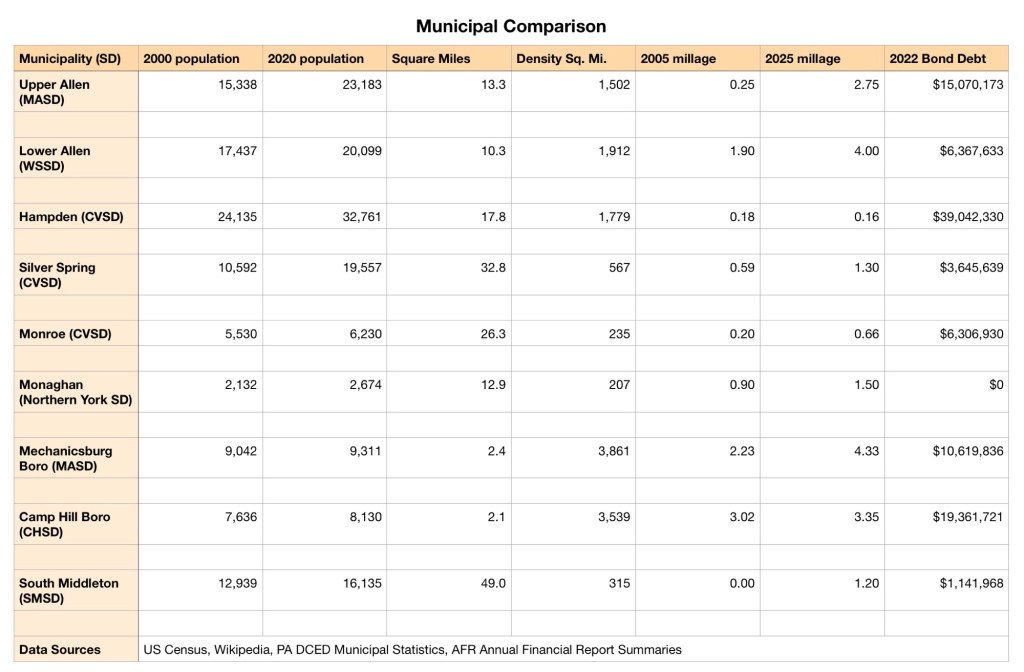
Here is our Municipal and School District comparison:
.

.
The data clearly shows Upper Allen has been much more aggressive in raising taxes than surrounding municipalities for over 20 years. In addition to pushing for more development, the majority Commissioners keep pushing for state of the art facilities, sports fields and parks.
Our analysis shows Upper Allen is now spending twice as much (after charges for services) on parks than any other municipality in Cumberland County. Instead of keeping the new 58.4 acre Generations Park passive and low key; the incumbents keep pushing for a 660 seat amphitheater, 500+ parking spaces, 8 restrooms, etc. All at a cost of $20+ million. Much of this would be a duplication of what we already have at Winding Hills park.
The impact of all the development on the school district is pretty clear and it is startling to see that MASD now has greater debt than CV.
DCED Municipal Statistics and Comparison with Lower Allen, Hampden and Silver Spring.
One of the better ways to learn about Township finances in Pennsylvania is to check out the Municipal Statistics page from the PA Department of Community and Economic Development (DCED). Below is a link to the DCED web page and a screen shot of what you will find.
We offer this information as a way to educate residents and to show we have taken a serious look at Upper Allen’s finances. Knowing how Upper Allen does things as compared to other municipalities is important for determining the best path forward.
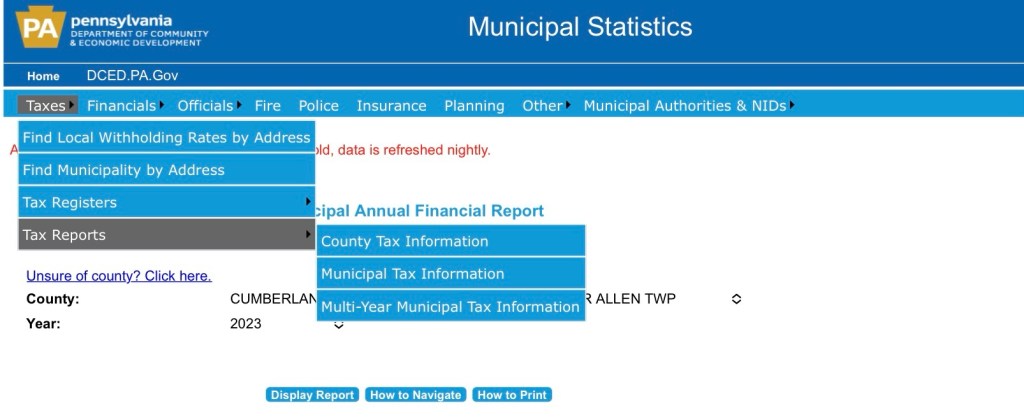
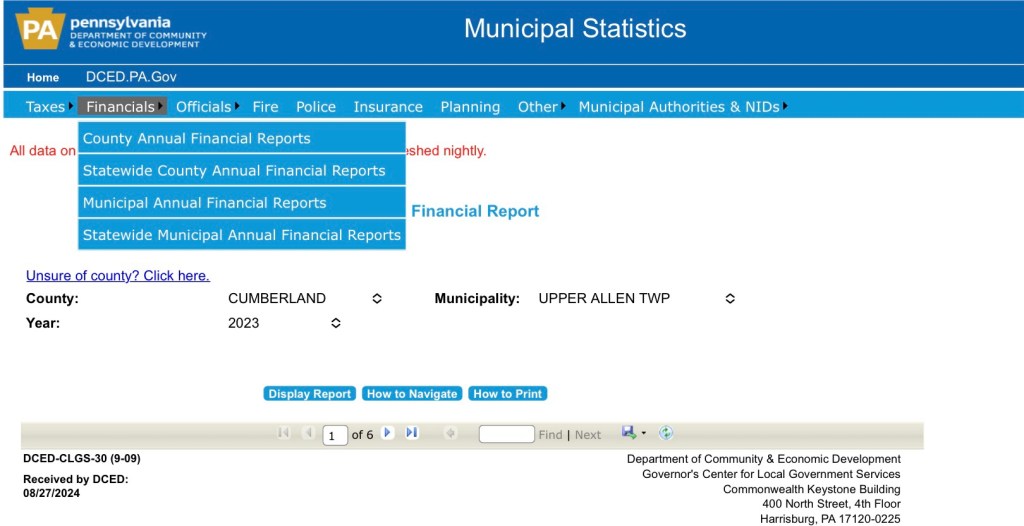
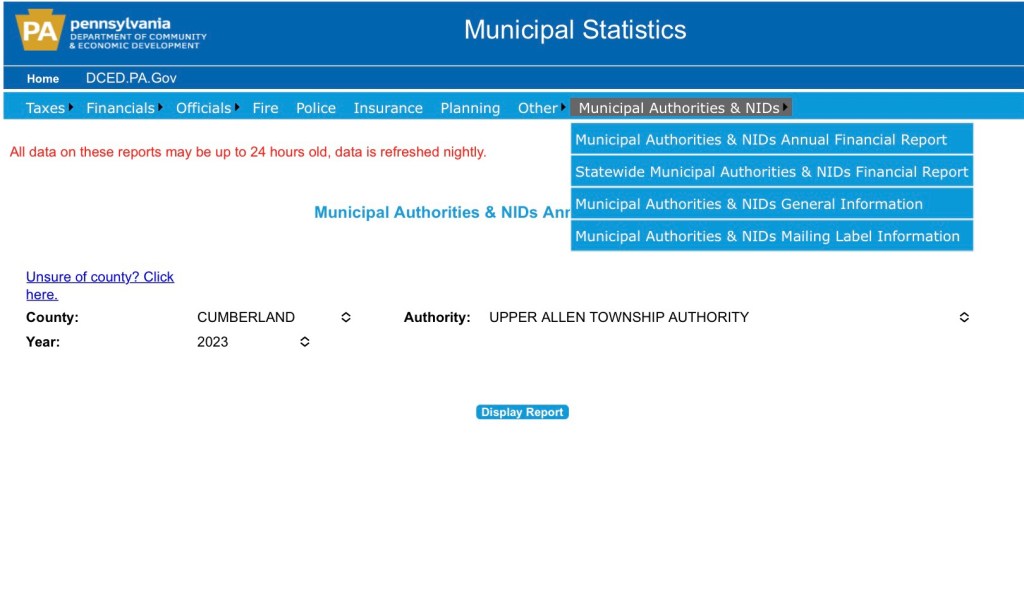
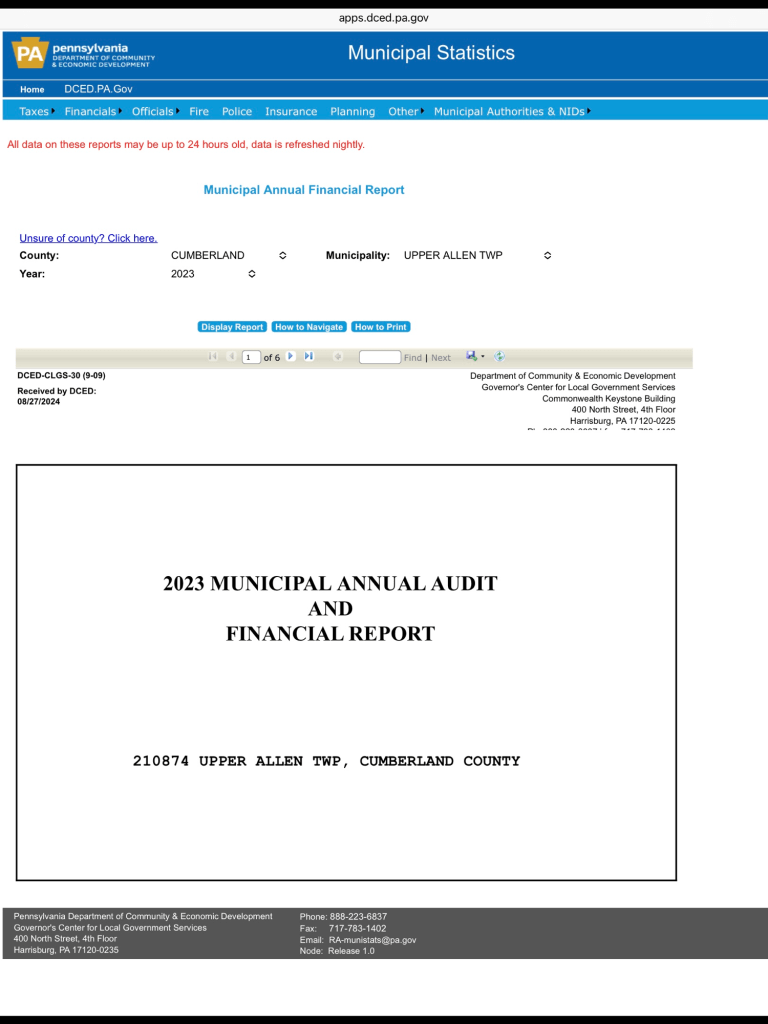
The photo shows the drop tabs that need to be navigated to get to the various reports.
We suggest the Taxes, Financials, and Municipal Authorities tabs as the most useful for gaining an overview of Upper Allen and other township finances.
The Taxes tab brings up Tax Reports and then municipal tax information. You first enter the County, then the Municipality and Year. Once, you are here; it is very easy to change Year(s) to compare tax millage. It’s also easy to change municipalities while in the same County file to compare data.
The tax files automatically pull in the companion school district millage rates and provide the combined millage total. Be aware that millage rates are different for each County depending on when they last did a reassessment.
Note that these are very “wide” spread sheets and that as you scroll to the right, there is more information.
The municipal tax information tab allows us to easily check tax millage rates over whatever years we want to see. For example, UAT’s millage was .25 in 2005 and 2.75 in 2025. We can do the same for Silver Spring; i.e., millage was .59 in 2005 and 1.30 in 2025. The tax information file goes back to 1988.
The Financials tab brings up a 6 page summary of the audited Annual Financial Report (AFR) issued by each municipality. The report provides a standardized format for accounts and descriptions; however, not all municipalities utilize the same categories. This may make some line item comparisons difficult, but the data will still be captured in the broader categories such as general government, public safety, public works, etc. The AFR file data goes back to 2006.
The Municipal Authorities tab is important because many municipalities run their Sewer or Stormwater services through an authority which reports separately. So, the authorities need to be considered as part of the overall picture. For example, Upper Allen runs its Sewer in-house vs. Lower Allen and Silver Spring which have separate Authorities for sewer.
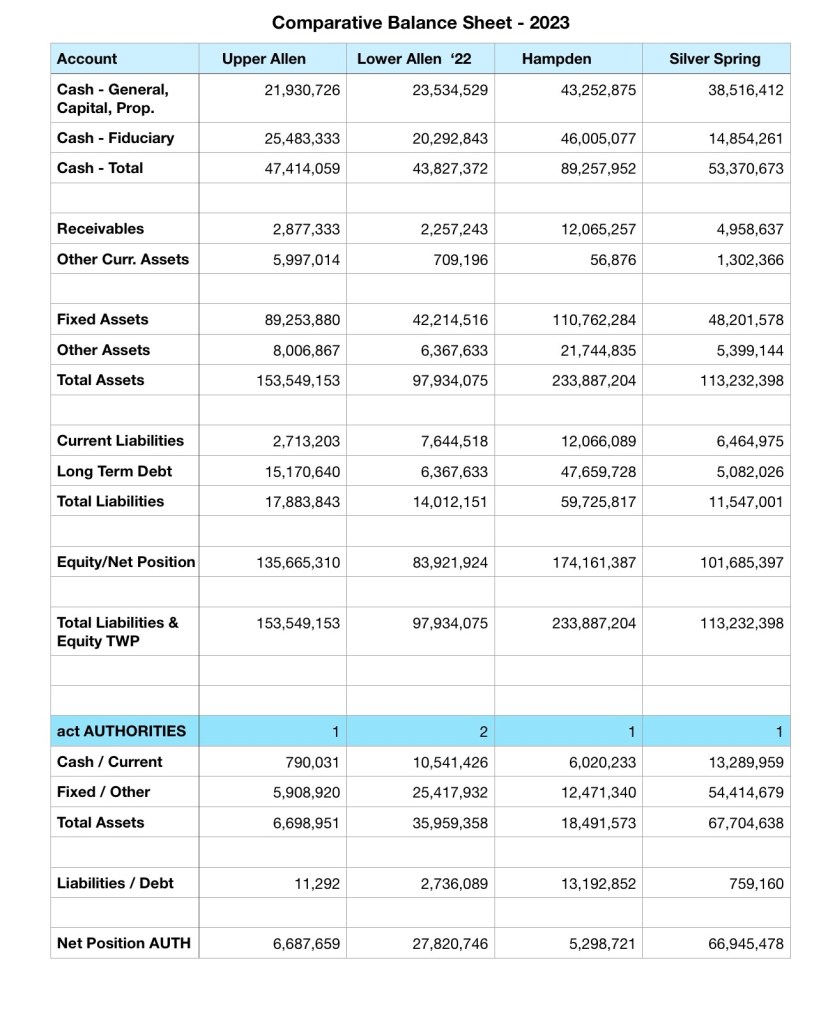
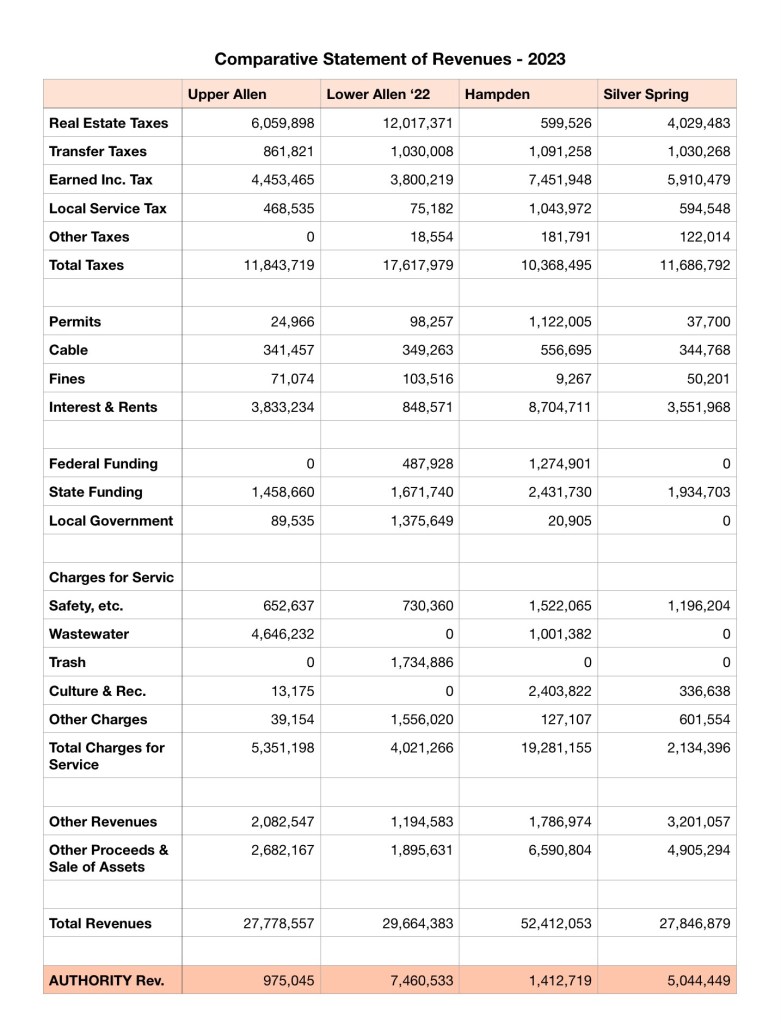
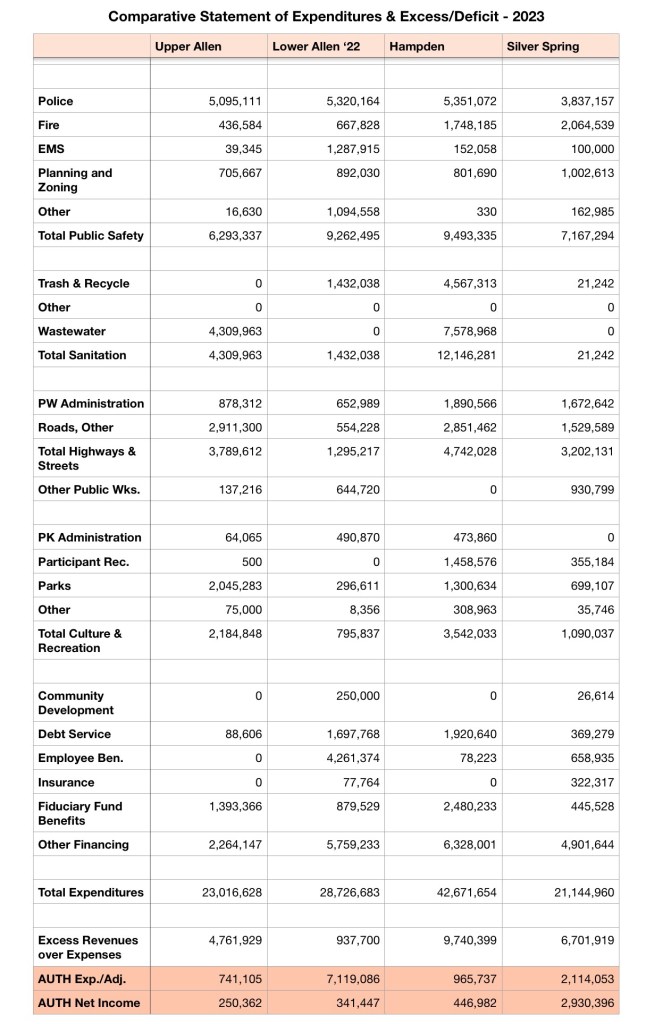
Here is a look at Upper Allen vs. our suburban neighbors.
.
.
Note that the Lower Allen data is for 2022. We combined the data for the 2 Lower Allen authorities (Sewer and Stormwater) for ease of presentation.
Authorities data is for active authorities only as there is no data for the inactive ones.
Much could be written about the ins and outs of this data and what it means.
One thing that stands out to us is how much healthier Silver Spring is on a financial basis; especially when we “add in” its Sewer Authority. More cash and less debt is generally a good indicator. Silver Spring also wins on having lower taxes and less population density than Upper Allen. Much of their success can likely be attributed to its leadership and having a land preservation program.
We also noticed that, in general, desirable communities with good schools often generate more revenue from the EIT than from property taxes.
At the end of the day, the finances are controlled by Commissioners and their priorities. Upper Allen has had the same three majority Commissioners for 20 years who have prioritized development, facilities and parks. Save Upper Allen believes there is a better way forward vs. more of the same.
.
2025 Budget
Here is the link to the 2025 Upper Allen Budget and a screen shot of the Master Spreadsheet:
https://cms3.revize.com/revize/upperallen/2025%20Budget%20Complete%20-%20Website.pdf
Note the Township Manager’s memorandum which gives an overview and color to particular projects.
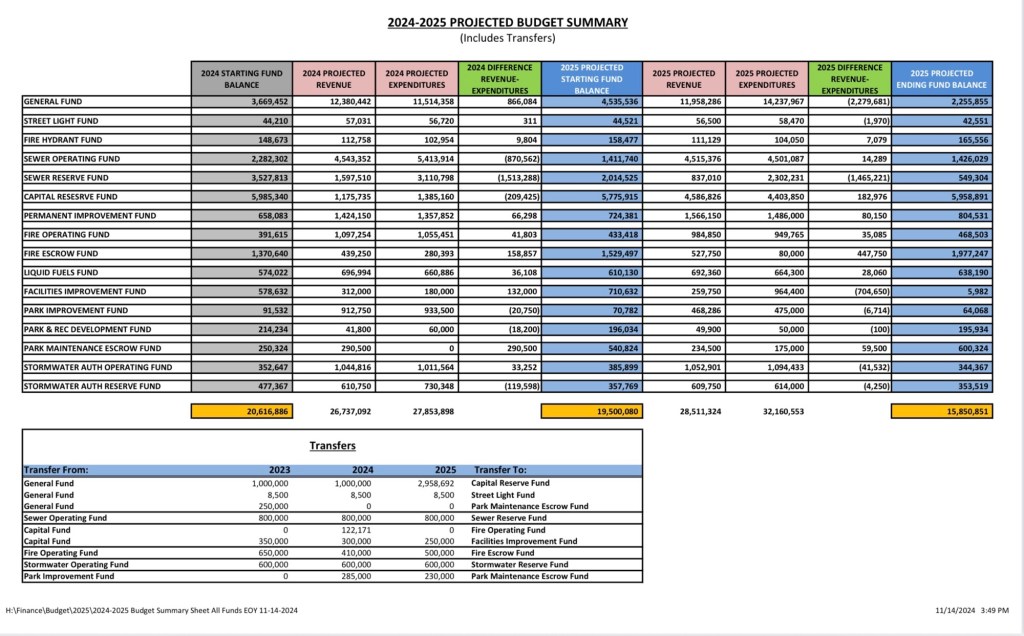
The budget structure is a bit convoluted due to historic precedents an apparent desire by some Commissioners to mask spending.
There is spending for feasibility, design and engineering for Winding Hill and Generations Park that is being paid directly from the 2021 Bond Fund vs. being shown in the budget.
There is money in the budget that will not be spent such as $1.5 million for sewer which was subsequently scaled back to $700,000.
The ending fund balances should mostly be higher than projected.
There is a longer form (56 page) version of the Budget that will hopefully be posted on the website in the future.
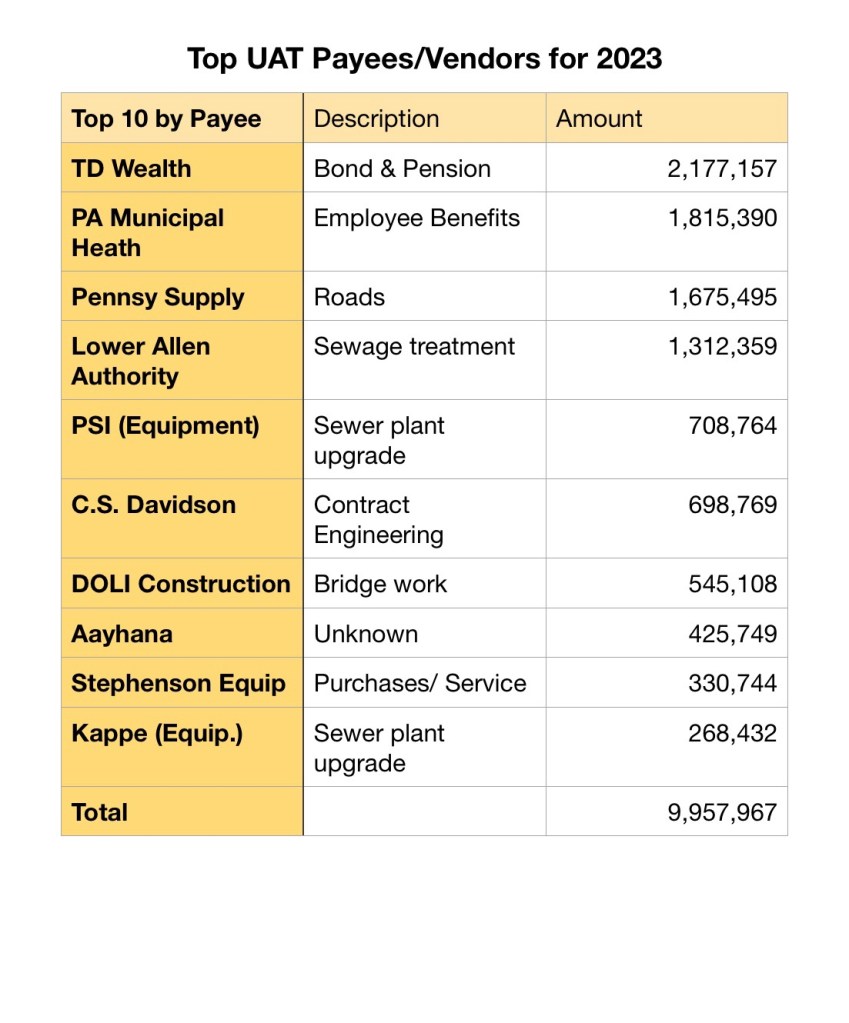
There are many ways to analyze expenditures. Here is an analysis based on “where” the money went in 2023 based on payments to Vendors:
October 16, 2023
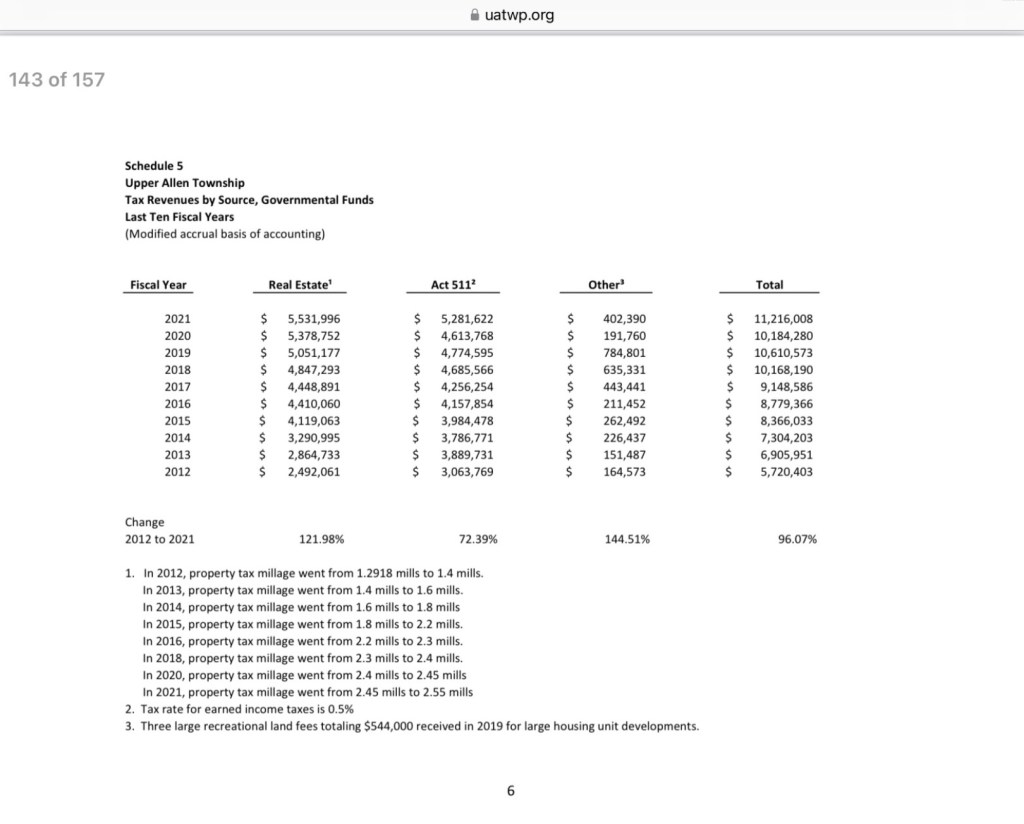
Upper Allen’s property tax millage has doubled in the past 10 years (1.29 to 2.55 mills). Upper Allen also gets .5% of the 1.70% collected by the earned income tax (See Schedule 5).
With all the development and a larger tax base, shouldn’t our taxes be going down?
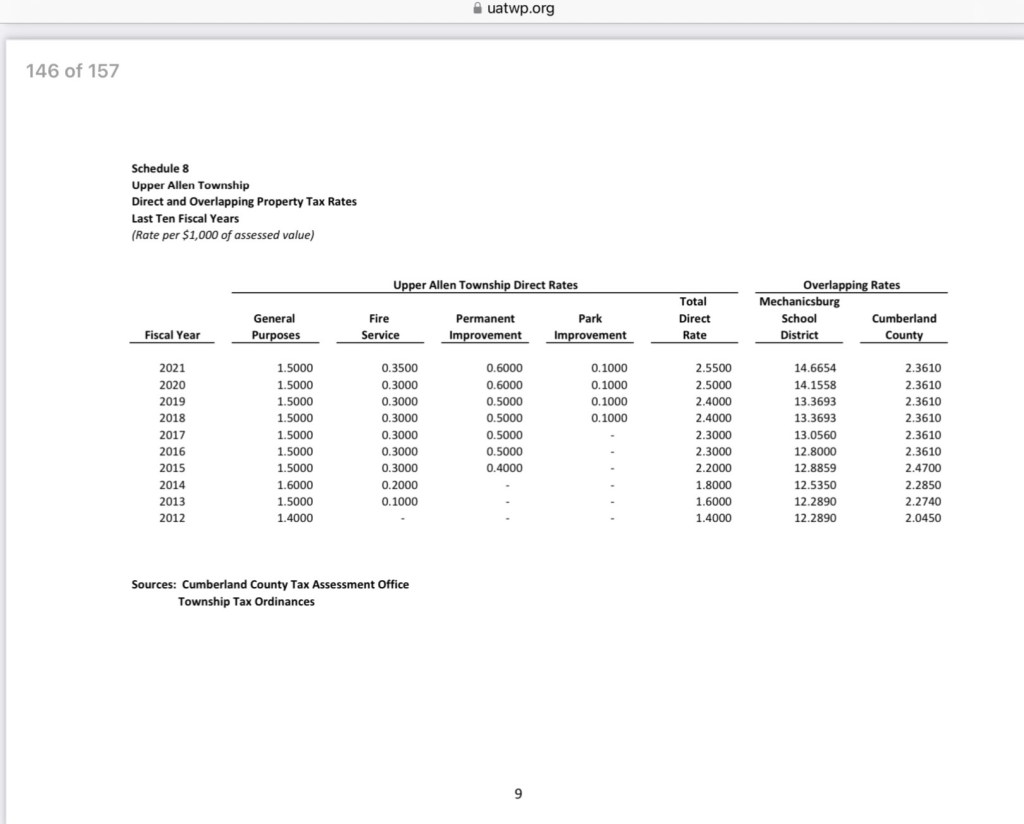
Cumberland County has held the line on its taxes. (see Schedule 8). Why can’t Upper Allen?
This data is from the 2021 “Annual Comprehensive Financial Report”. The full report can be found here:
https://uatwp.org/wp-content/uploads/2022/09/UAT-ACFR-2021.pdf
This report is required by the State and provides a wealth of other information such as demographics, largest taxpayers, largest employers, “overlapping” tax rates and debt (with school district and county), operating metrics, capital assets, etc. Note that some information excludes “business type activities” such as the sewer and storm water authorities.
Various schedules near the end of the report provide 10 year summary data which is helpful in discerning trends. Here are some of the more important schedules:
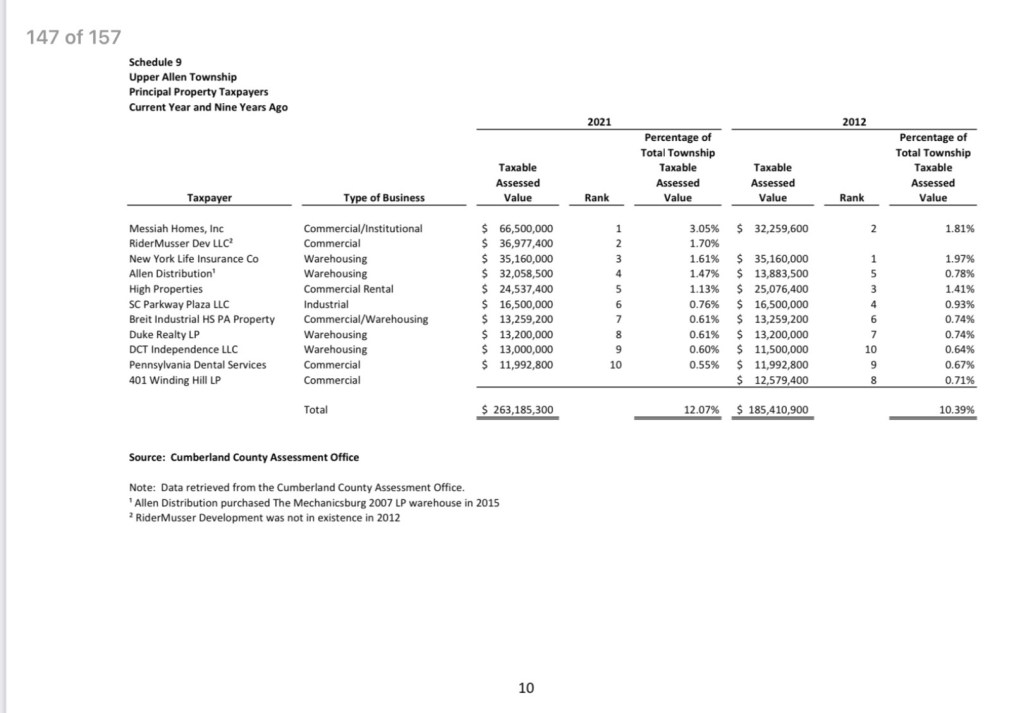
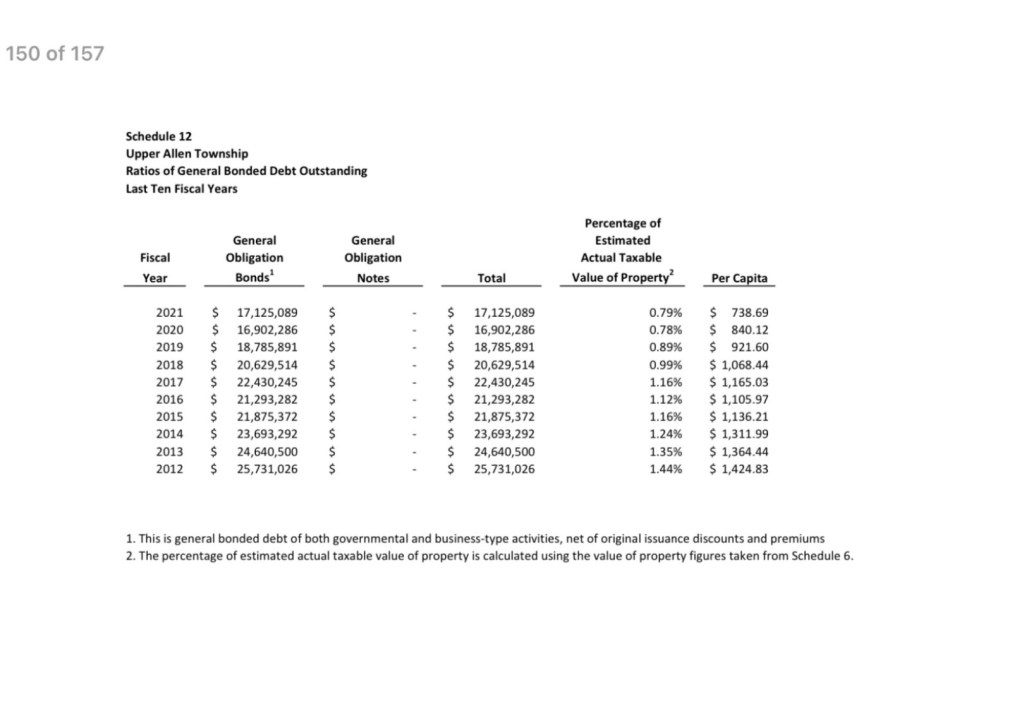
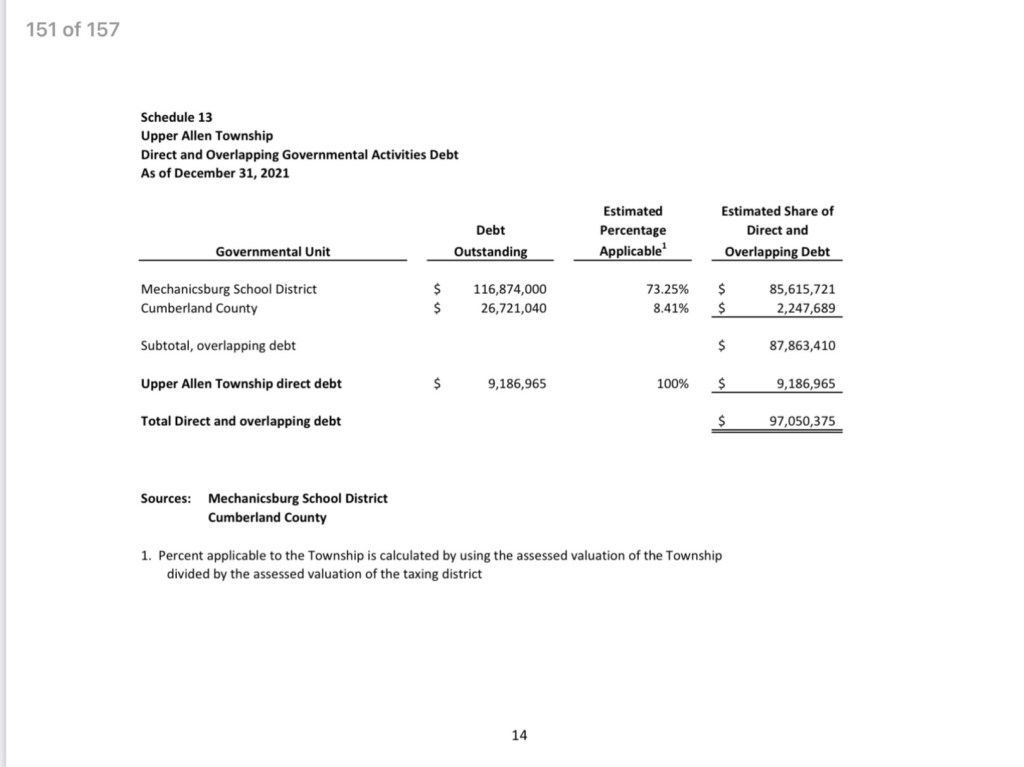
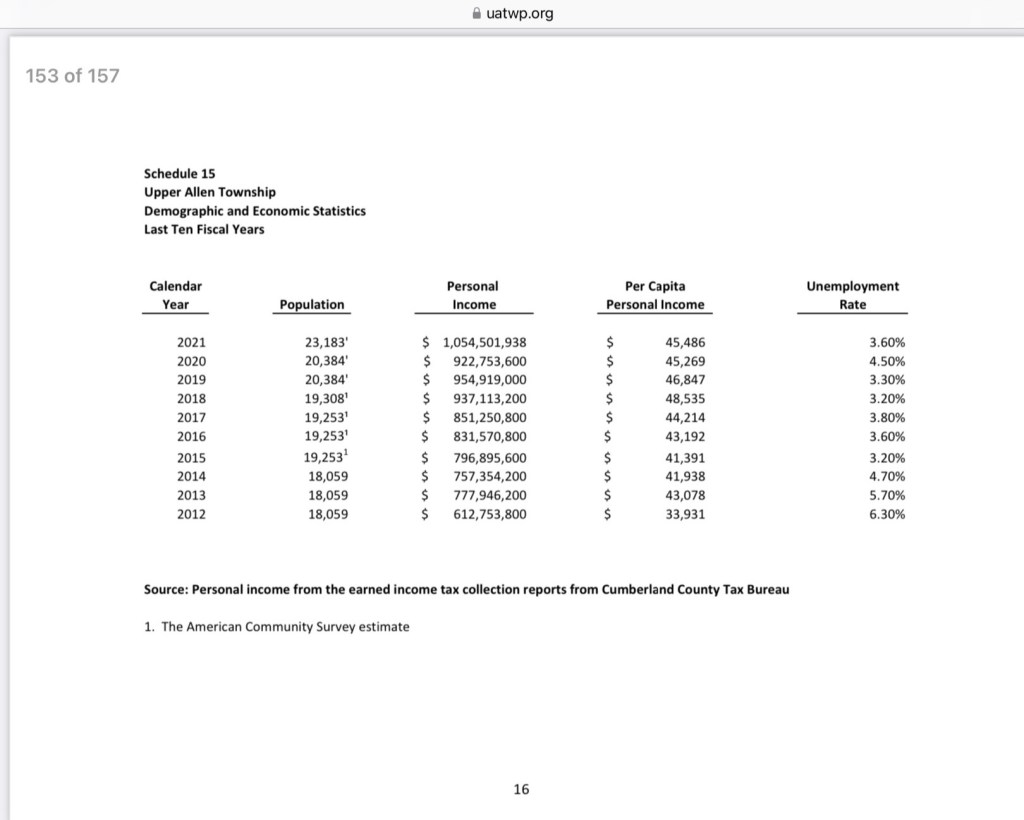
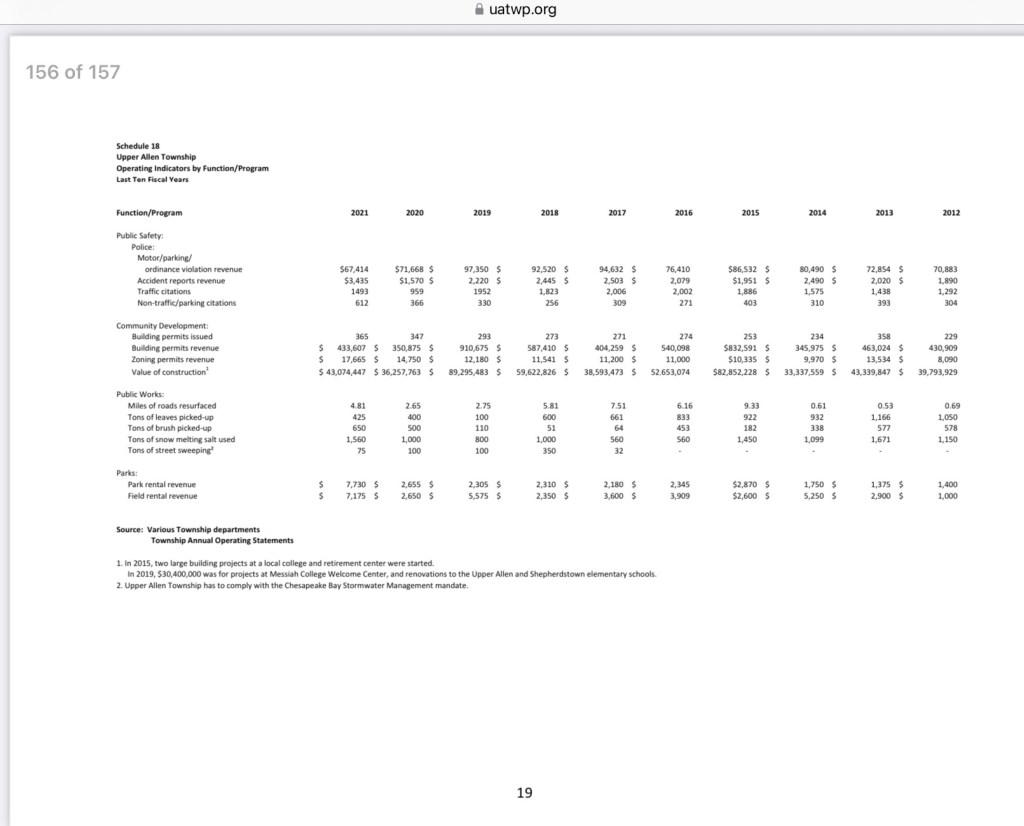
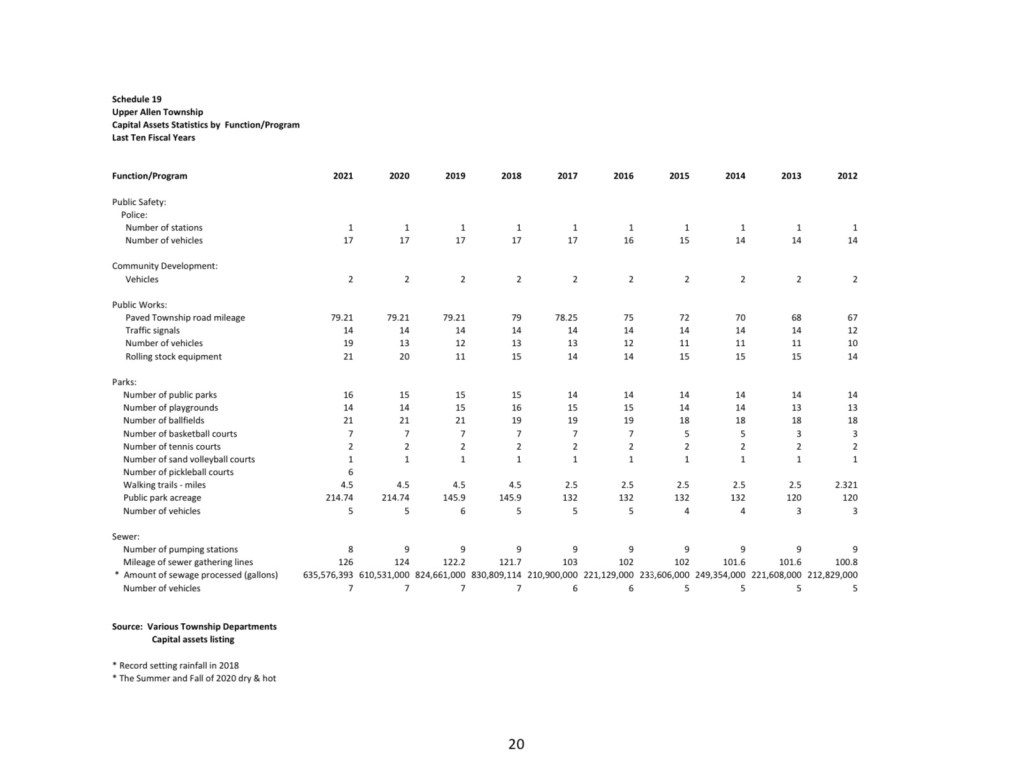
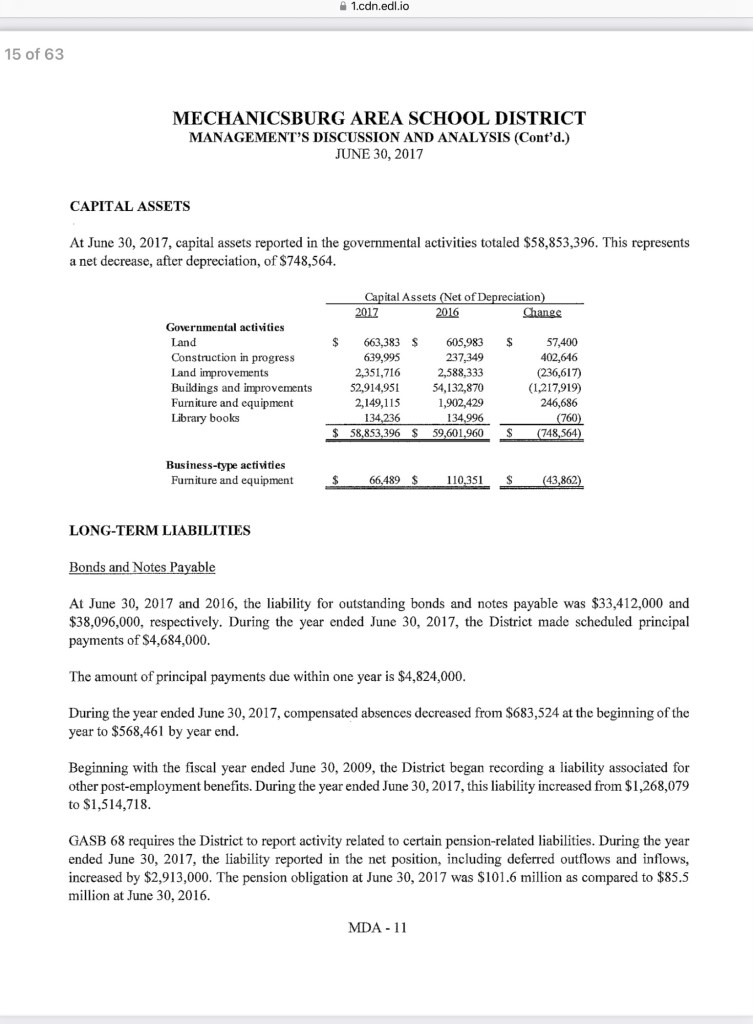
Mechanicsburg Area School District presents financial reports going back to 2017. The school district operates on a June 30 fiscal year vs. December 31 for the township.
The school district reports show property tax millage has increased 19% in the past 6 years (12.89 to 14.67 mills) and debt has nearly quadrupled from $33.4 to $121.8 million:
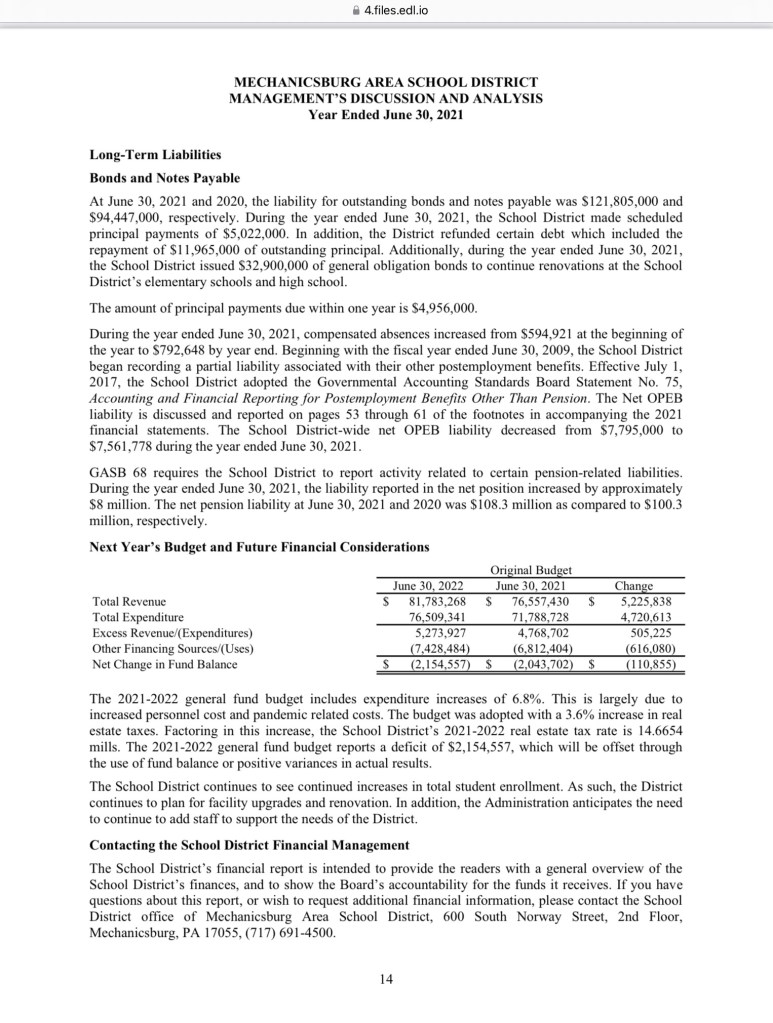
The June 30, 2021 “Financial Report” for the School District can be found here:
https://4.files.edl.io/4e12/02/09/22/150135-f9969619-6a71-47ab-886a-42e017e0ba5e.pdf
Costs of new infrastructure and services needed for development are being shifted to local taxpayers. And costs that outpace revenues are being funded with debt – debt that will eventually need repaid. The numbers say we are NOT better off from all the recent development and we need to be smarter about development.
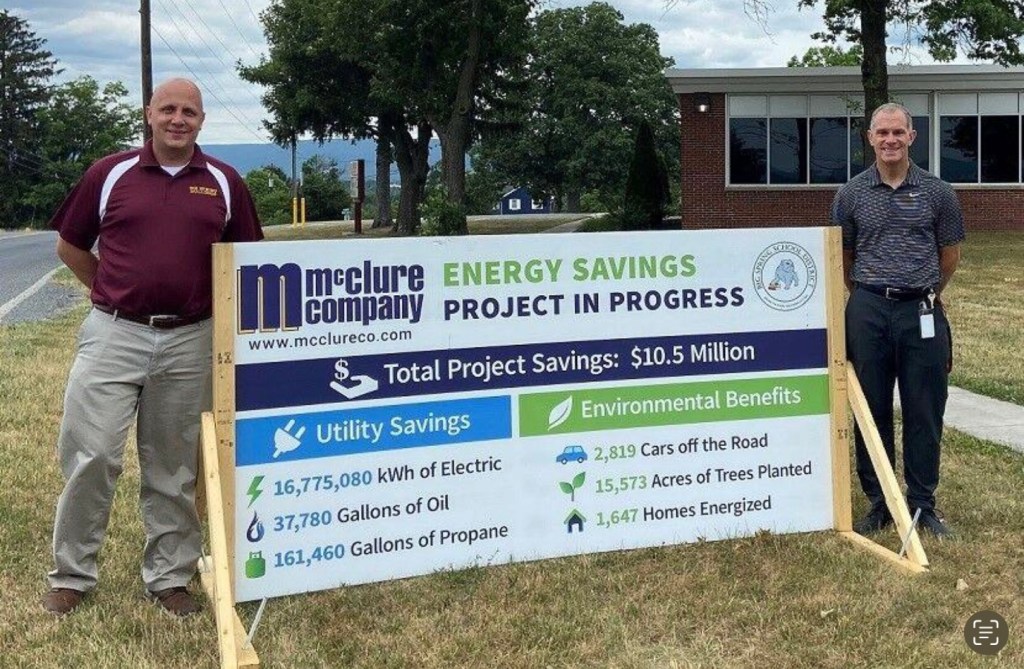
As true fiscal conservatives, Eric and Phil will be frugal with your tax dollars. For example, the incumbents plan to spend $1 million to replace the HVAC system in the municipal building which is only 11 years old. We will review and likely vote against this project given ventilation issues could easily be addressed by portable fans and air filters or an Energy Savings Contract such as recently done by the Big Spring School District. Same with the $1.5 million gate house, $2.5 million (relocated) amphitheater, and 547 parking spaces slated for Generations Park.
The Annual Budget now exceeds $25 million. See
https://uatwp.org/wp-content/uploads/2023/03/entire-budget-for-website.pdf
Upper Allen has a unnecessarily complicated budget structure using 13 separate funds, multiple transfers between funds, and repetitive data entries to create a 147 page document for 2023. By comparison, Middlesex and South Middleton Townships have 9 and 32 page budget documents respectively.
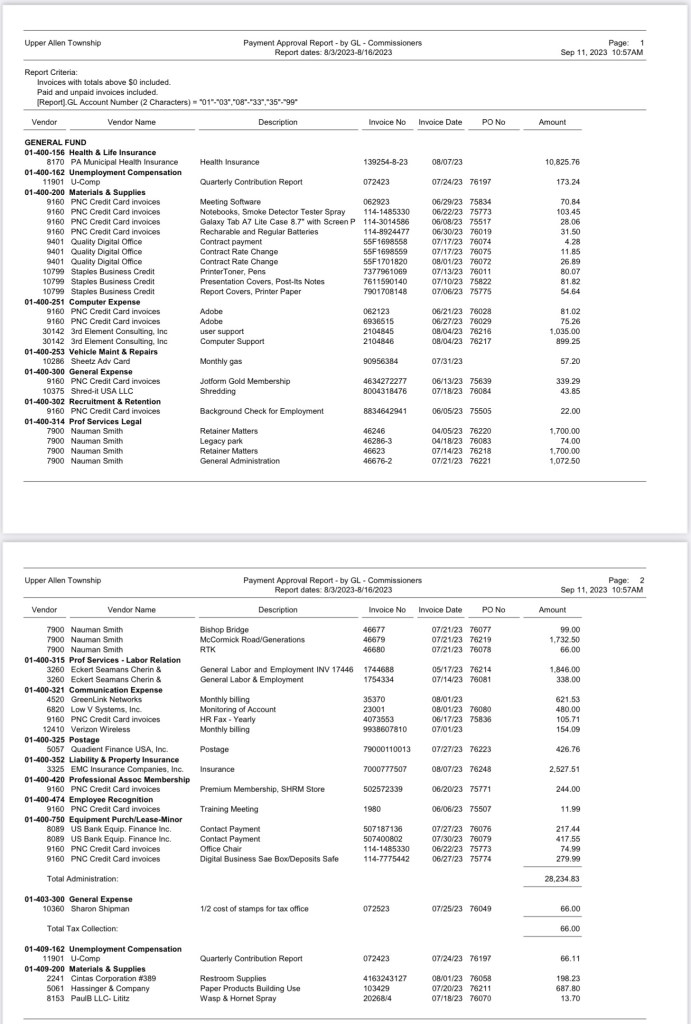
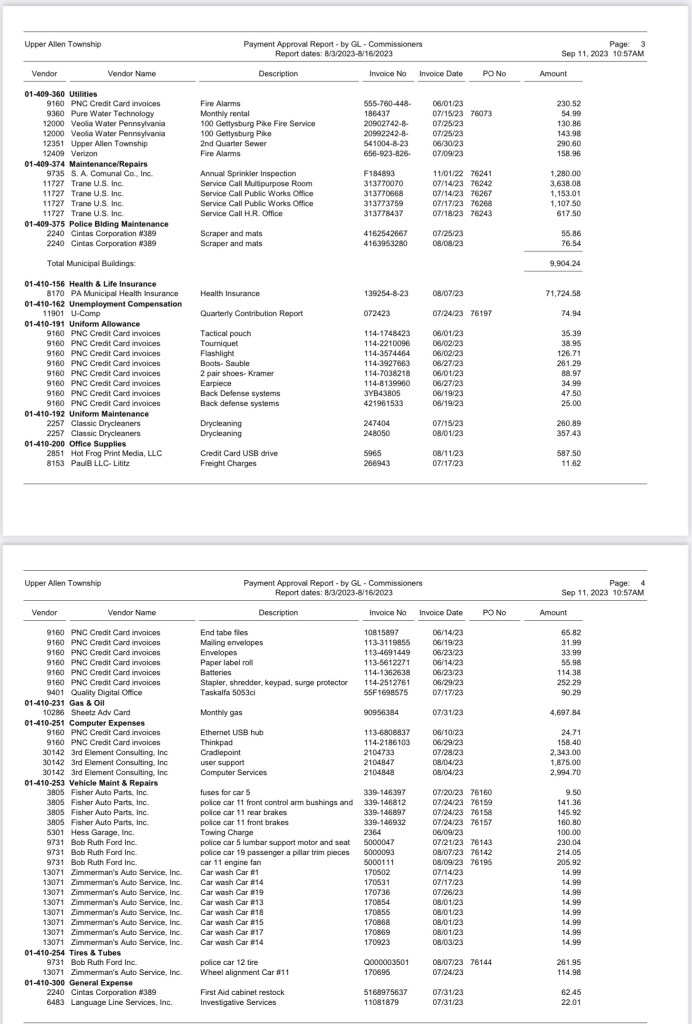
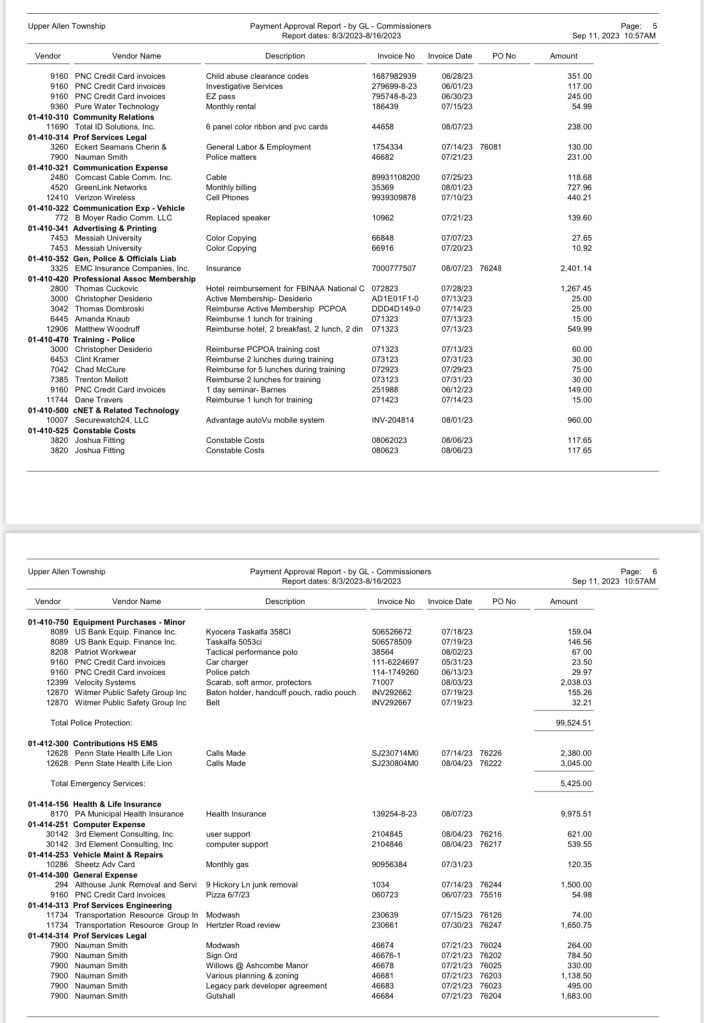
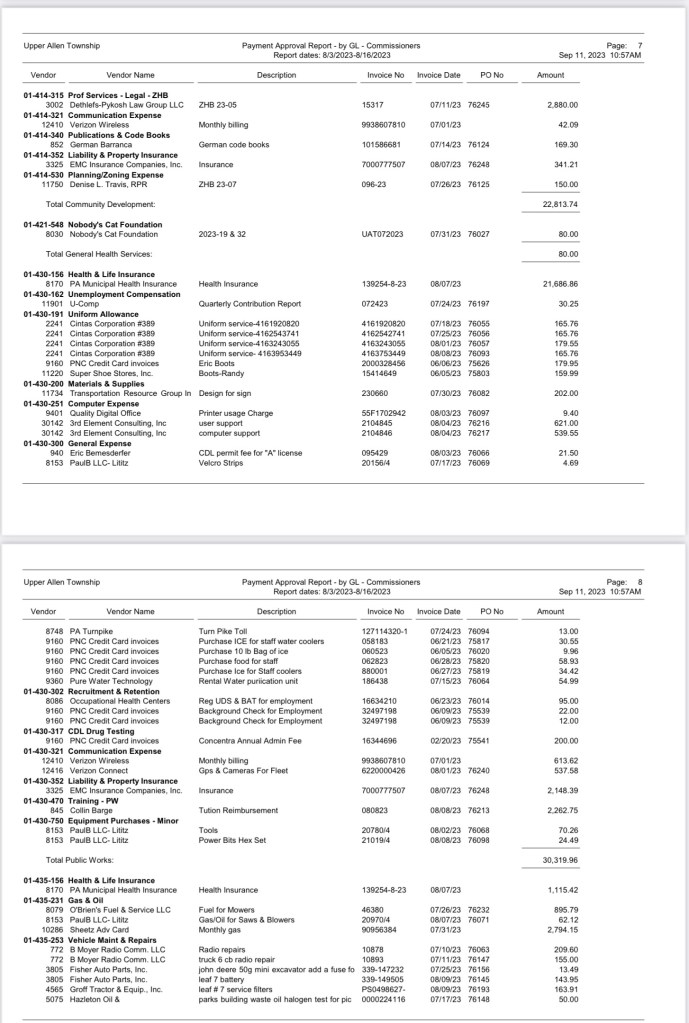
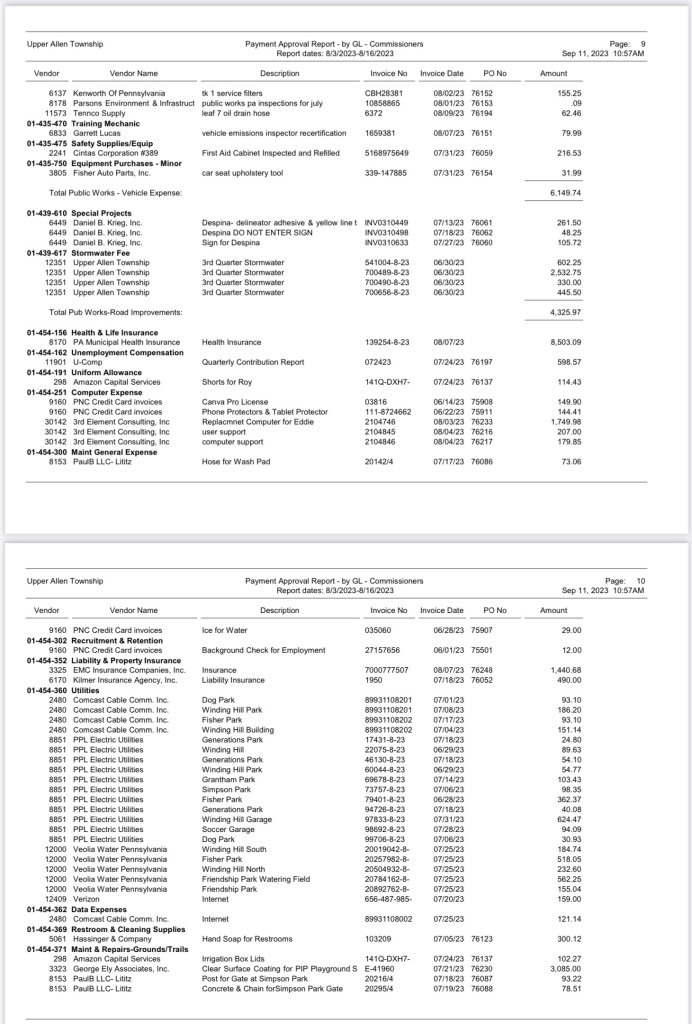
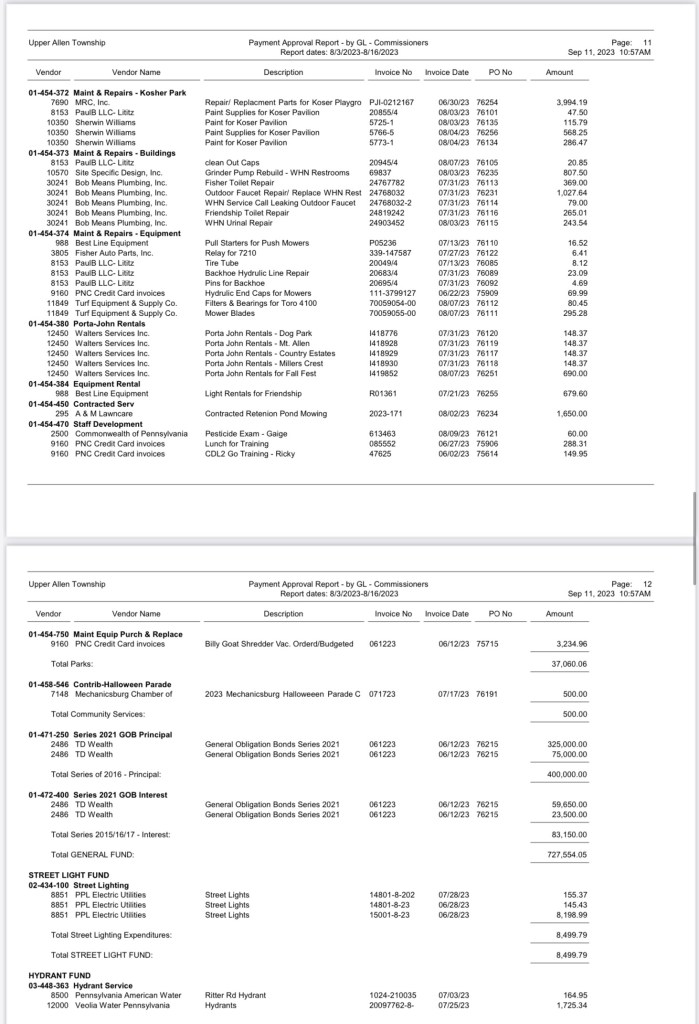
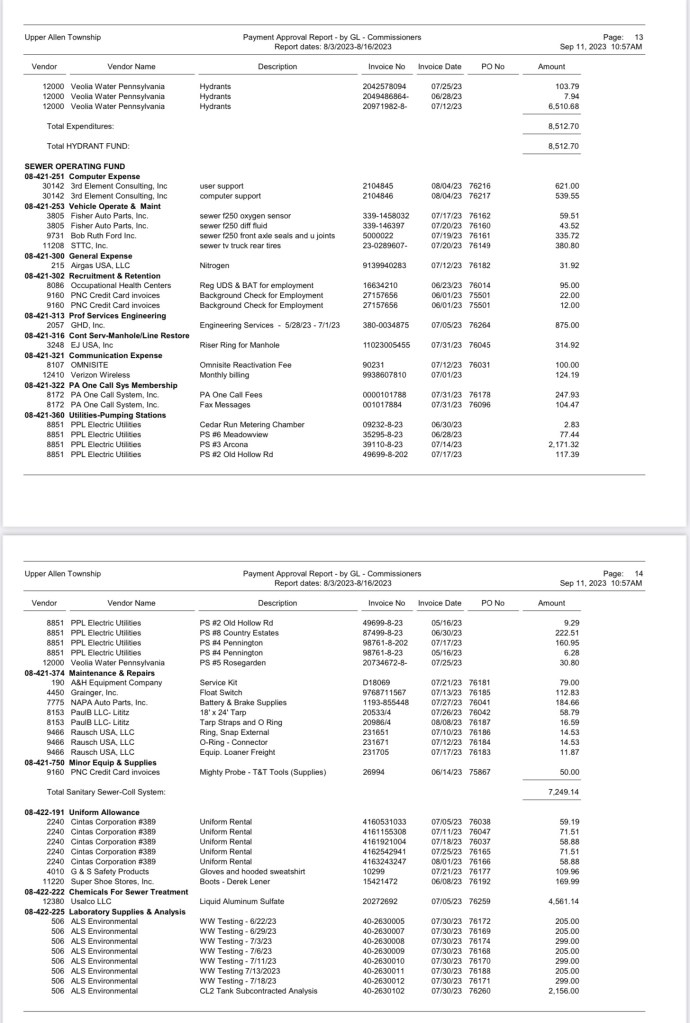
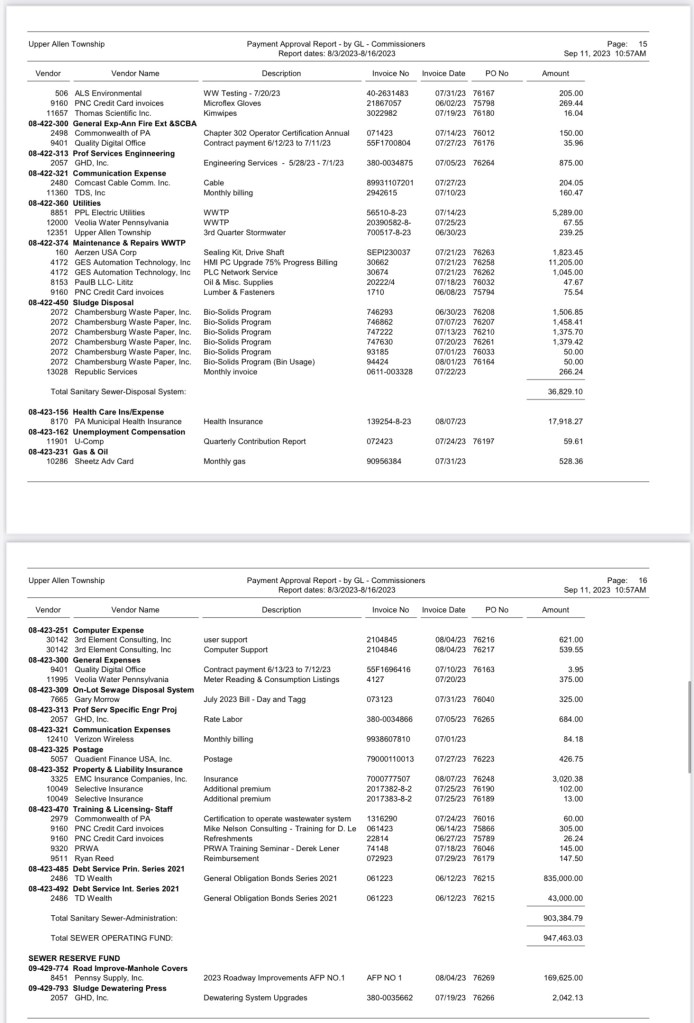
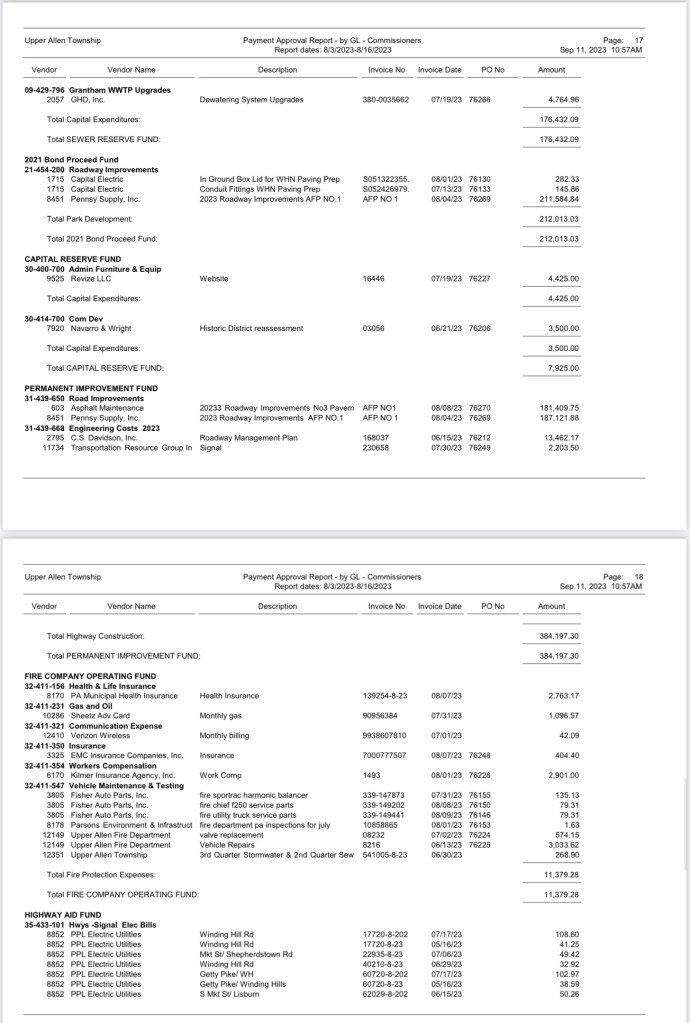
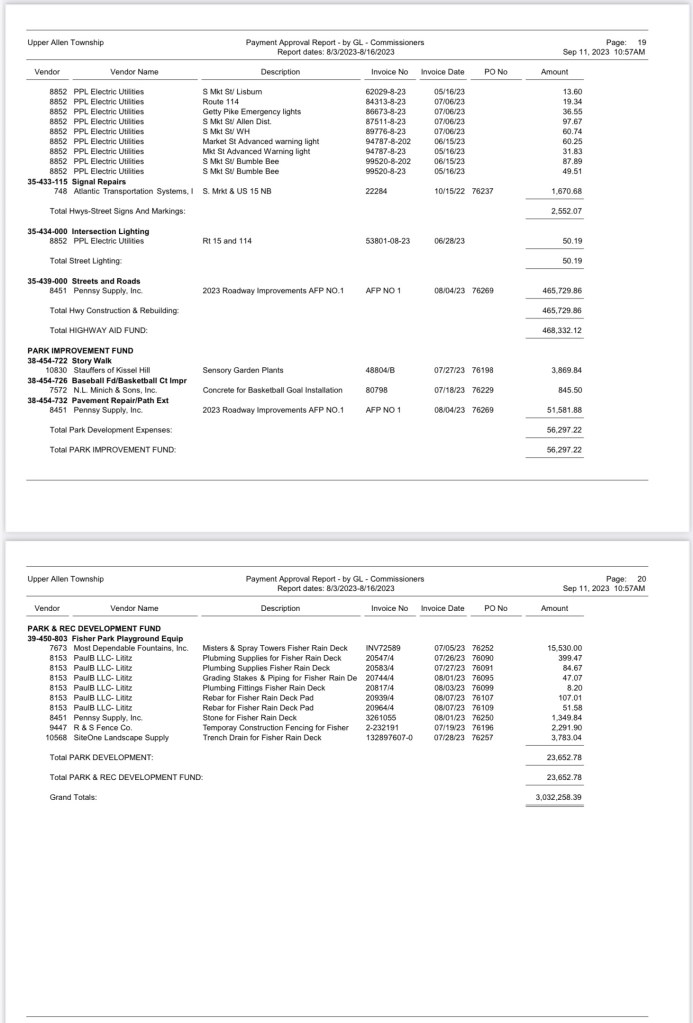
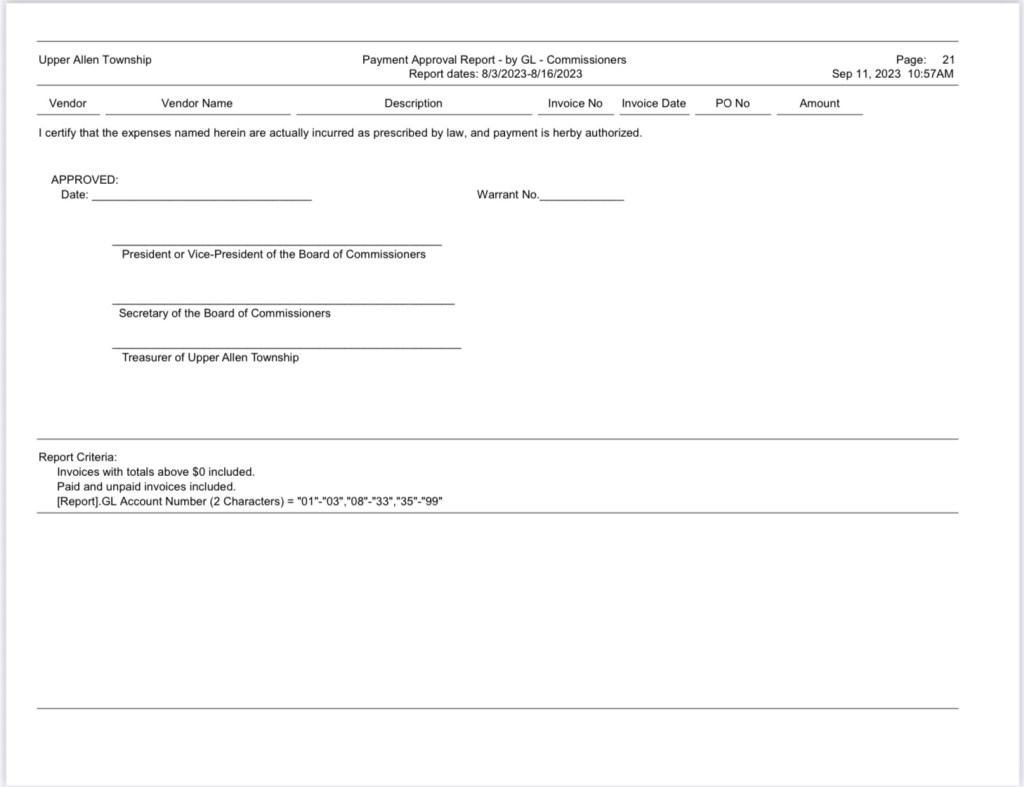
A listing of $3,032,258.39 Bills Approved at the August 16, 2023 Commissioners (BOC) Meeting was recently requested. The township provided this information; however, not in a format that can be linked. Here is a detailed look at how Upper Allen spends taxpayer money:
 Save Upper Allen